Saturday, 4 August 2018

Keeping Notes


Time for our next British piano, which is actually German - an 85-key Steck belonging to Marion's stepmum, Marilyn. It originally belonged to her mother, Marj.

L-R: Marj, Marilyn & Marion
Stanton Drew


Fall Board


Thanks to Roberts Pianos, Oxford, who published the serial numbers, it appears to have been built around 1929/30. You can also find a large list of model numbers in the Blue Book of Pianos.

Click to Enlarge
It's hard to date a piano by its serial number because you have to take a rough guess at how many pianos they manufactured each year. The serial number on this piano is 101169. Between 1920-40, Steck made 79,500 pianos, so roughly 3,975 per year. Adding 3,975 to the original 1920 total of 63,300 brings us to 1929-30. All depending on whether or not they made an average number of pianos each year. If more, it might be earlier. If less, it might be later.

We did find a little something that backs up our theory, though.


Lifting out the upper panel, some markings became visible along the ivory keys.


These appear to be the dates the piano was tuned. They're written in dark-blue ink in the centre of the piano. It wasn't until later that we spotted some fainter markings in pencil to the far left.


The one on the second key reads 1934.

It's fair to assume it was tuned a year or two after it was built. So, somewhere in the region of 1929-1934, most likely 1930-33. A pre-war German piano.

[UPDATE: Thanks to our friend  Jim Kelly at  Fur Elise Piano Service  for letting us know that the Aeolian embossing on the plate means that it was likely made at 155 New Bond Street, London!]

It's just really interesting to contemplate whether the piano had the same tuner all those years, or whether Biro Tuner saw Pencil Tuner's marks and thought 'that's a good idea, I'll continue doing that'. Was Biro Tuner a friend of the family or were they just a local tuner who came to the house year after year? It's fun to speculate.

Unfortunately, the piano has fallen into some disrepair over the years. Many of the hammers don't fall back, the strings are a bit rusty and the heads and dampers are worn.


But the piano is a family hand-me-down, so there's a chance that piano enthusiasm will spread and the instrument will be restored.

After giving it an overpull, it was time to head to the pub. A nice pint by the river at The Boat in Ashleworth, which had been run by the same family for over 350 years until recently.


Wednesday, 25 July 2018

Birdcage


Breaking the silence. Marion's been in the UK visiting family over the past few weeks, and there have been a lot of pianos involved.

In no particular order, we're going to share a few here. We're all still learning about pianos, so it's been a useful field trip as there aren't many of them in Kigali. One of the most educational experiences was visiting Aunty Anna and cousin Tamsin. Tamsin and her partner, Guido, came to Rwanda last year. You can check out her blog here (takes a while to load). They even blagged a front-row seat at Kwita Izina, the annual gorilla naming ceremony.

President Paul Kagame
Hanging out in Kigali at PiliPili,
who also have a piano.

It was fantastic to catch up with family, and Aunty Anna even made a special Africa-themed chocolate cake.


But before any of that could be eaten, there was time to explore the piano in the corner of the room. If there's a piano anywhere in the room, Marion will take it apart. 

All pianos are slightly different inside, but no one was expecting this...

  
Apparently, it's called a 'birdcage', or an 'over damper'. The dampers are above the hammers and connected to the keys on long, thin wires which give the action its birdcage appearance. Truly fascinating design, but a nightmare to tune. This one at least has enough space to insert a tuning hammer, but no room for the tuning dampers. 

There was no obvious maker's mark or serial number. It's probably behind the action, which looks like it would be quite a job to remove.

It also has another unusual aspect in that the strings are strung vertically, rather than overstrung.

Vertical

Overstrung

There was a little silver key taped inside the lid, and a rather spooky story that, one night, the piano mysteriously locked itself.    

According to this fascinating article on birdcage pianos, they're usually later models from around 1900s-1930s, with one manufacturer, Berry, continuing in England until 1954, mostly putting actions into older, reclaimed casings. The likelihood is that it was built by Kemble. If there is a K before the serial number, this would confirm it. It's in very prim condition inside, and the keys are plastic rather than ivory, so I'm guessing somewhere between around 1935-1945, unless it's a later Berry action placed inside an older casing.

A truly impressive, if somewhat convoluted, approach to piano-making. 
 

Monday, 16 July 2018

Pipe Down


Hello!

Sorry we've been so quiet. Marion's in the UK at the moment and Désiré is busy with his carpentry business. Here's a little video clip Marion made from Hollowell Steam Rally last weekend, which is the next village along from where she grew up. Some nice shots of musical organs, but also serves to illustrate the difference the steam age made to industrial progress. Piano posts to follow shortly.

Thursday, 14 June 2018

Earth School Wurlitzer


Picture of Désiré putting our new scroll saw to good use. Also got some better shots of the bridge he's made, so you can see how intricate it is.


Truly a work of art. Unfortunately, we're still a way off stringing yet. Securing the soundboard and inserting the tuning pins is going to take a bit longer. Meanwhile, Marion's off to the UK for a few weeks. Chillington are working on a quote for the action frame for us. Bahoro bahoro, as we say in Rwanda - slowly slowly.


In other news, we were at The Earth School in Kiyovu on Tuesday to tune their Wurlitzer console. It definitely wasn't an easy one to work with. Lot of dust and spiders inside, and the screws on the action frame were a bit stuck until the oil worked its magic. The action really didn't want to go back in again afterwards, so one of the teachers was drafted in to help.


It wasn't easy finding the serial number, either. We think this is it in the bottom left of the frame. Hard to read, but looks like 372718, which would place it roughly around 1948, we think.


Along with spiders and rusty strings, a mouse has also had a go at C8 and its bridle strap.


The biggest issue is the worn hammers and dampers. The dampers are so worn that it sounds as though the sustain pedal is down, even when it's not.


It's a nice instrument, though. Despite the worn hammers, it sounds clear enough. We gave it an overpull and will fine tune it once Marion's back. Also going to test out our ironing equipment to try to buff the hammers a little.


And as it was one of the teacher's birthdays, there was also cake. Piano tuning and cake - always a good combination.


Friday, 1 June 2018

Bridge to the Other Side


We've been holding off posting for a while in the hopes of making a big announcement about stringing, but it's taking longer than expected. Marion is off to the UK for a few weeks and we're trying to get to the stage where we can string up the prototype before she leaves. That will give the new strings time to stretch and settle, so that we can tune them on her return.

The bit that's been taking a while is getting all the pins aligned on the bridges. Désiré has been working overtime to craft these complicated parts, which keep the strings evenly spaced and taught. 


Example of bridge pins from this site.

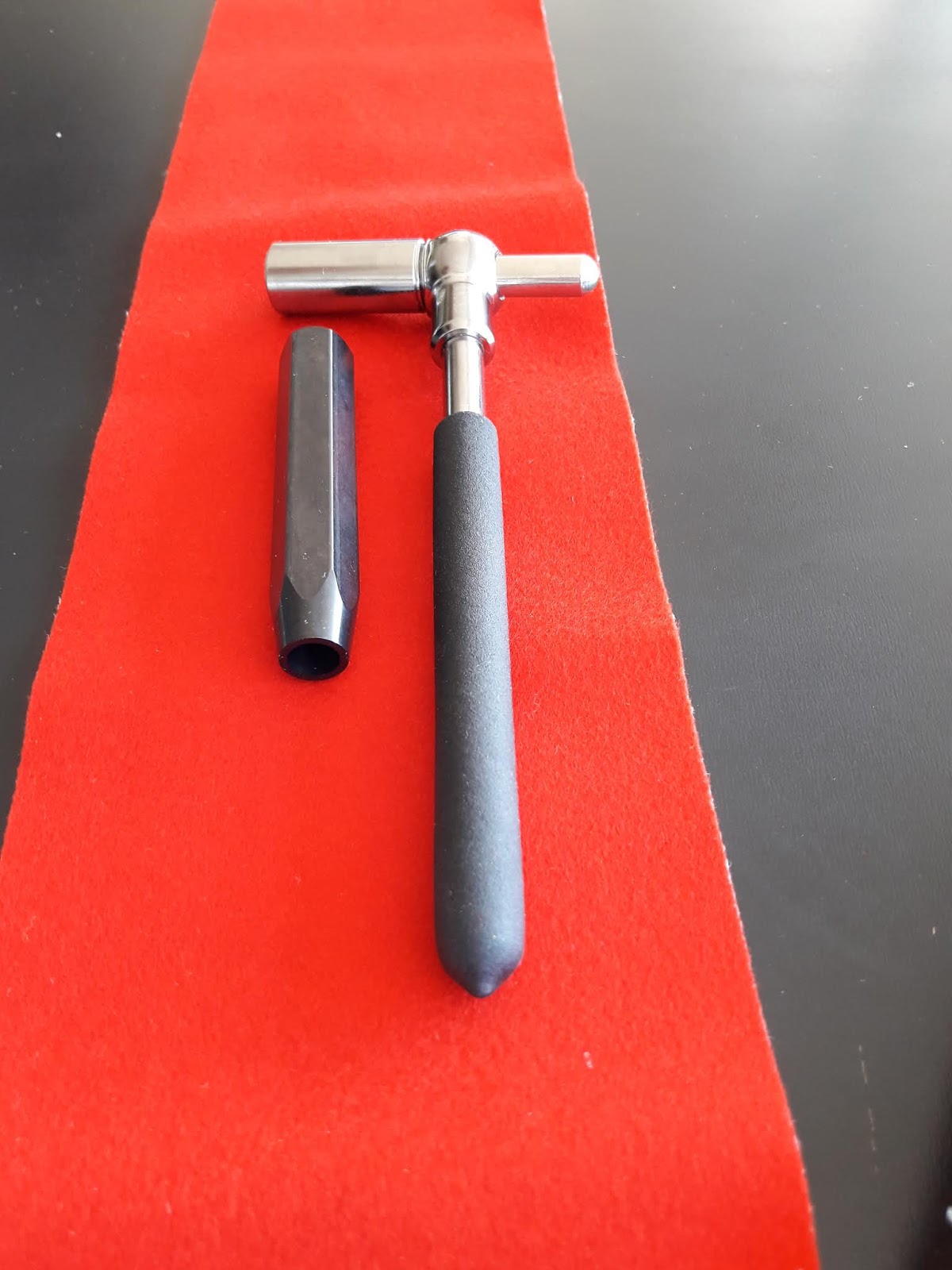
Now that they're almost finished, it's a case of mounting the string frame and hammering in the tuning pins using these pieces of equipment from Howard Piano Industries. The black one is a tuning pin punch, which goes over the pin to protect it when you hammer. The silver one is a tuning pin setter, which helps to ensure that all the pins go in at the same depth. We're talking around 220 tuning pins, so it takes a while to do by hand.

Friday, 18 May 2018

88 and Out


Finally taken all 88 hammers off the action frame last week and delivered it to Chillington to see whether they can replicate it. 

Started by taking each hammer, damper and whippen off one by one and labelling them, then discovered it was easier just to do six or seven hammers, then dampers, then whippens, then labels. Sped things up a bit. Whole process took about five hours.  


Gave the whole thing a bit of a wipe down. Fifty years of dust in between the pieces.


Not to mention a wee eight-legged friend. Not sure how long she's been there, but we hope she owns earmuffs.  


Popped the frame out in the sun to dry.


Then, the next morning, Marion sat the frame on her lap and took it by public moto to Chillington. Public motorbikes (motos) are the fastest and most convenient way of getting around the city, and the frame was surprisingly light with all the hammers removed.
 
Public Moto
Piano Action on a Moto


Now it's just a case of waiting to hear what Chillington say.